Ezra Klein is Pessimistic about global warming.

There is an article at Vox by Ezra Klein that is well worth reading.

He has seven reasons why America will fail at global warming. If you don’t want to read this, he also has a brief video “conversation” with Te-Nehisi Coates at the top of the page in which he summarizes the points he makes in more detail in the article.

Klein’s argument is pretty straightforward. We’re too late getting started fixing the climate (if it is fixable), and our political processes do a poor job of taking on a problem that requires long-term sacrifices for less-than-immediate gains.

He does a good job, too, of showing how the Republican position on putting a price on carbon has changed radically since John McCain ran for president (and lost). McCain supported it. He also writes about why we can’t expect to engineer our way out of the problem scientifically.

All of this is pretty depressing, but he also does a good job of covering his butt at the end, saying he is pessimistic but not fatalistic. He hopes a solution will emerge.

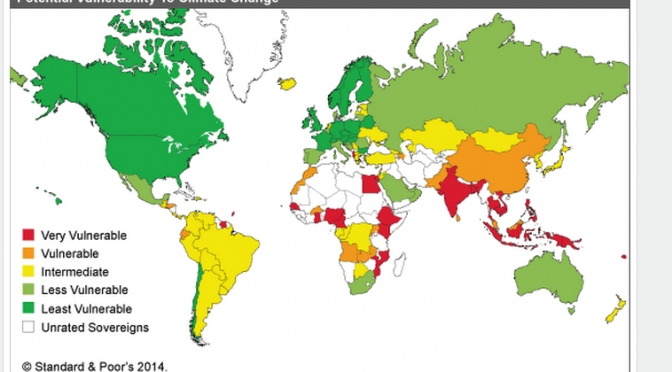
As I watched him talk with Coates in the video I realized that while Klein was limning the depths of the coming disaster, he was also painting this as an obvious problem for America. But as this map shows, while the US may produce a disproportionate percentage of the world’s carbon emissions, we also have one of the biggest cushions for absorbing climate change. It isn’t really our problem yet, unless we look further into the future.  (click to enlarge)

Screenshot 2014-09-23 09.39.36Klein quotes Matt Yglesias on this: “Very few of us are subsistence farmers. Relatively few of us live in river deltas, flood plains, or small islands. We are rich enough to be able to feasibly undertake massive engineering projects to safeguard our at-risk population centers. And the country is sufficiently large and sparsely populated that people can move around in response to climate shocks.”

So, the question becomes, how do we convince Americans to make significant changes and sacrifices when the short term threat level isn’t nearly as dire as the long term threat?

Marching felt great, we should do more of that, but we need to keep talking broadly about how the system works and why it isn’t really designed to answer this question. Maybe, I worry, we’re not designed to answer questions like this one as a species, but I’m not pessimistic. I’m pretty sure that we will hammer on this problem, as other ones, with increasing urgency. And while we talk about it and argue about it and elect public officials who recognize the problems, we’ll make progress.

Will it be enough, soon enough? I hope so.

The Art of Plumbing

most700Alexander Melamid was co-author of a book, with Vitaly Komar, based on public opinion polls about art. The basic idea was to ask people what they wanted to see in paintings, and what they didn’t want to see. And then paint the paintings people said they wanted.

The project is archived at Dia.

Melamid’s new project is another stab at the art world’s pretensions. His idea is to add another recycling bin to those we already have. Paper, Plastic, Metal, Compost, Art. He says:

I think we need to open up the recycling station. Our world is polluted by art. It’s millions and millions of objects that are created every day. So imagine there are recycling bins: plastic, paper, art … .

Plumbing has something to do with it.

Recommended: Ben Fountain, Billy Lynn’s Long Halftime Walk


After finishing Billy Lynn’s Long Halftime Walk: A Novel I read Geoff Dyer’s review in the Sunday Times Book Review of May 18, 2012. Or reread, probably, at least partly. My approach to book reviews is flexible. I read them if I’m interested in the non-fiction subject, even a little.

I read fiction reviews if I like the writer or I like the reviewer, or if the writer or reviewer I don’t know captures me for some reason. References to books and writers I like help. But it is hit or miss.

If I start reading a review, for whatever reason, and think I might read the book, I stop. It isn’t pleasurable to read with a critical voice in your head, no matter whose. Read the book first, read the review later. Same goes for movies.

I’m sure I at least started Dyer’s review of Ben Fountain’s book because I like reading Dyer, and I’m sure I stopped because I thought I would read the book, which I eventually did and have now finished.

All of which is to say that Dyer’s review gets the book, and does it without even mentioning Beyonce’.

What I can tell you is the book is a love story, and like all love stories it’s a wish-fulfillment scenario. The fact that that mostly-dry humping mise en scene intersects with the War in Iraq, Bush 43 giving medals, Fox Television, the Dallas Cowboys, Hillary Swank, Destiny’s Child, a twisted dysfunctional and sweet family, and many vile and some sweet characters, and is written with vivid access to metaphor that captures life in these United States these days, is secondary.

But not unimportant.

Will It Waffle?

Screenshot 2014-09-08 21.55.23This picture is a detail from the picture that ran with the original story I read about making waffles of everything. But the waffles I made looked just like this.

A guy named Daniel Shumski wrote a book called, brilliantly, Will It Waffle?

I read about the book in Slate.

I also made the zucchini parmesan waffles tonight, based on the recipe at Food52.

I’m looking forward to making spaghetti and meatballs in the waffle iron.

LINK: How St. Louis County Profits From Poverty

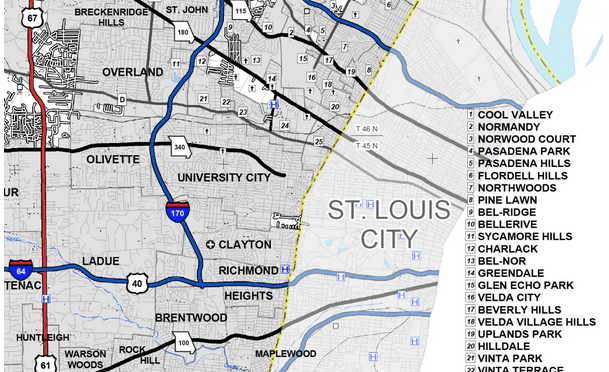
Screenshot 2014-09-04 09.42.34One of the most important jobs of journalism is to explain the way things work. Or, in the case of St. Louis County and its many municipalities, how they don’t work. Radley Balko explains it all in this long and hugely worthwhile Washington Post story, which does a masterful job of making one feel the aggravating and humiliating context of the Ferguson demonstrations, as well as lining up a surprisingly bureaucratic and appalling series of villains.

In this case, a history of white flight, a checkerboard of self-serving municipalities that rely on legal fines to pay for themselves, and the slow development of a social culture that results in outstanding bench warrants that stifle the efforts of citizens to get a job or job training, or most egregiously, to run their own businesses.

Click the image to see the map of numbered municipalities larger. Each given its own stretch of highway from which to profit.